
2025: A year of Compression, Not Expansion
For me, 2025 was not about adding ideas but about enforcing pragmatic compression.
Previous years were about expansion, adding domains: AI, product development, ethics, civilization thought, art, design, governance, metaphysics, etc.
2025 was a deliberate reset.
Earlier intelligence was power, leverage, and amplification. 2025 reframed intelligence as duty under constraint. For example: moving from “What AI can do?” to “What AI must answer for?”. This forced me to dwell on intent, moral agency, governance, and system boundaries. System performance no longer impressed me as much as traceability, accountability, and consequence chains. This was not a technical shift. It was a philosophical one. Intelligence creates debt, not merely advantage. I obsessed about AI design, feedback loops, organizational computation, and complexity science, not because it was managerial but because it was moral. I also realized that this orientation carries the danger of over-engineering.
This quietly reorganised everything.
I became less of a collector and more of an integrator under constraint. The theme shifted from curiosity to responsibility. While I was designing and running a digital product with real-time operational consequences and scanning the horizon for AI futures, I was forced to confront how unaccountable abstraction had begun to lose meaning. It stopped interesting me.
Finally, 2025 also forced me to understand that sometimes over intellectualization is a form of emotional containment. We often process conflict, uncertainty, and personal pain by retreating into abstraction. Systems thinking can offer clarity but not emotional resolution.
Some ambiguity must remain for us to remain human. So, by the end of 2025 my personal philosophy is less about exploration and more about reconstruction. That systems outlast individuals and therefore must be built with humility. That chaotic, messy civilizations encode wisdom which optimization alone cannot rediscover. That the quest is no longer about becoming sharper but building more gravity. Earlier I thought and wrote as a lone actor. But 2025 forced me to begin thinking in terms of centuries.
From individual excellence to civilization continuity. I found myself gravitating towards civilization intelligence, Indic epistemologies, and long duration timeframes.
Short-termism of discourses and quick-fix optimization techniques had begun to bother me as I became more aware of intergenerational effects and path dependencies. My impatience with shallow discourse and transactional conversation grew as I began to see time itself as a moral dimension, and to feel the loneliness of the time horizon we now occupy. This placed me at odds with dominant technical/social narratives as I think continuity is intelligence. And that is the lens from which I evaluate AI, organizations, societies, and leadership. 2025 made me less interested in speed and more interested in direction as now I try to anchor intelligence in memory, culture, and accumulated restraints.
2025 found me fixated on intent not as a motivation but as an executable property. Whether AI systems, governance, rituals of the future, I was keen to know how intent is encoded, distorted, or lost as systems or societies scale. I explored ways to contain intent, which I suspect leaks under complexity.
One of its fascinating features is that order emerges without any single controlling agent. As I learned more about Complexity Science, my discomfort increased with both authoritarian control and laissez faire chaos. My interest in feedback loops, emergent traits, decentralised ethics, and civilizational norms deepened. The tension between creativity and burden increased as 2025 forced me to move away from “What do I think?” to “What must be preserved, translated, and carried forward responsibly?”. Therefore Art, writing, image generation, narrative building: for me creativity became a function of stewardship rather than self-expression only.
How this philosophy lives in relationships, employment, rest, joy, and surrender is still being negotiated. This is not a flaw. It is flow. It is the next phase.
Thank you so much for reading. I do not claim to be any kind of expert. I am just an observer, and I write what comes in my heart. So, if you liked this article, don’t forget to press that clap icon as many times as you want. Follow for more such articles!
And if you like to read an interesting book on AI then click in the link to my book: The AI Codex: Power, Ethics, and the Human Future in the Age of Intelligent Machines
Recent Blog
-
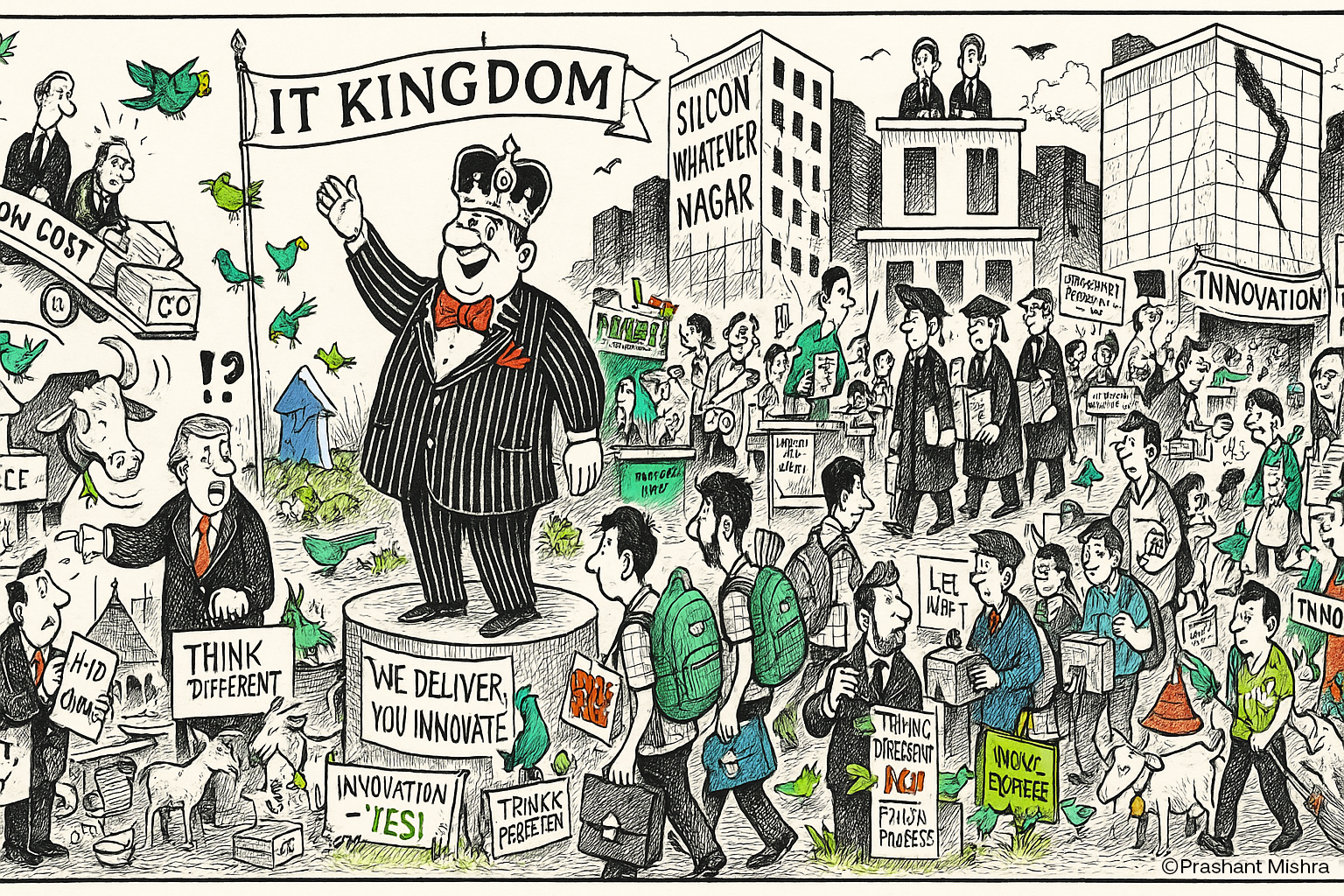
Galgotia’s Dog & India’s AI Aspiration: The maharaja has no clothes. But he is learning to weave.
Prashant M. 18 Feb, 2026 -

Culture in the age of AI: The Illusion of Revival
Prashant M. 14 Feb, 2026 -

When Existing Is Enough : Ud Jayega Hans Akela, Jag Darshan ka Hai Mela
Prashant M. 04 Feb, 2026