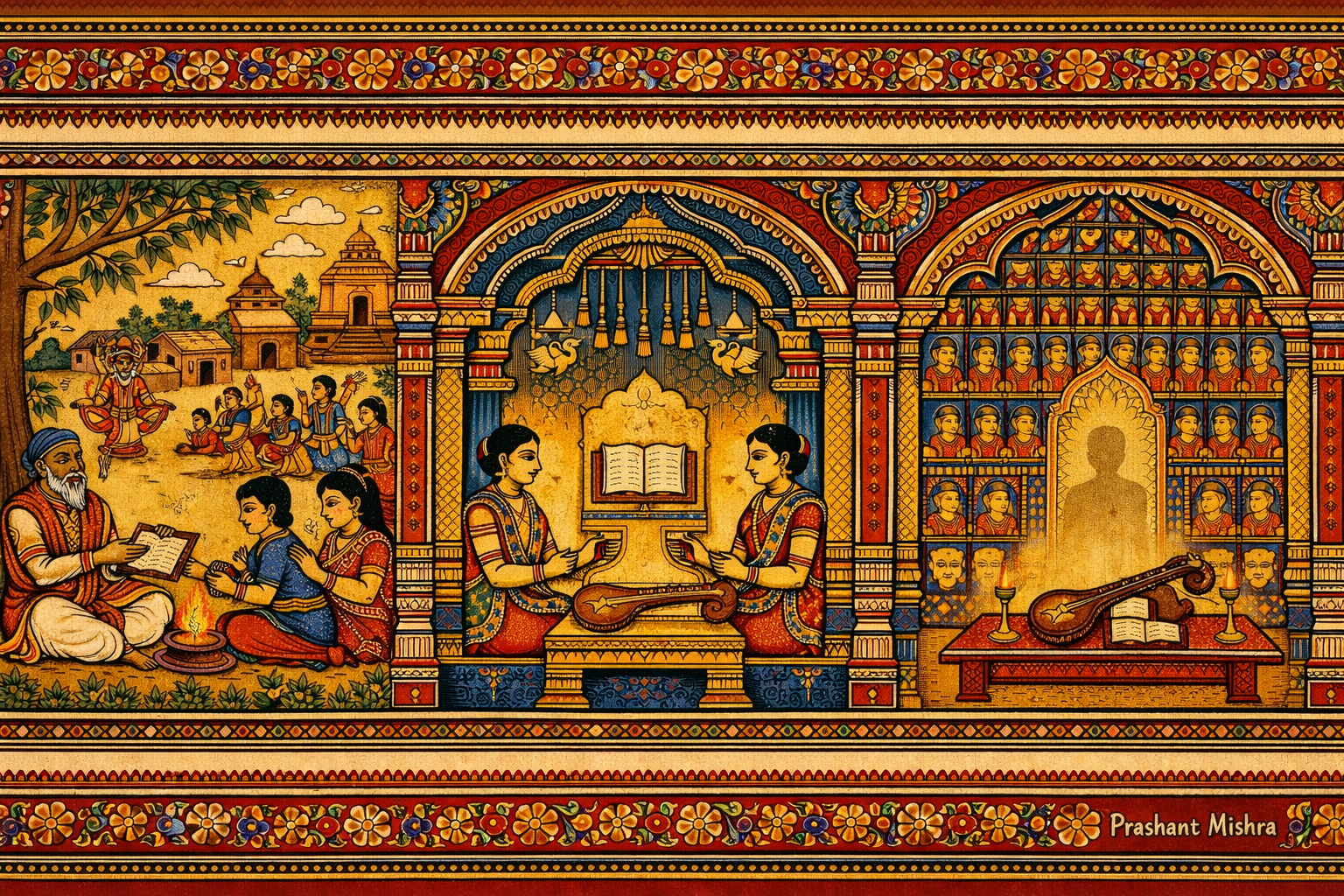
Culture in the age of AI: The Illusion of Revival
Baudrillard’s theory of Simulacra captures the challenges posed by the evolution and rapid assimilation of AI. AI generated Synthetic truths are not just imitations of the truth, but they are also hyperreal constructs that may not have any original reference points. Like Baudrillard’s Simulacra, these synthetic truths function as truth in a world where truth itself has become indistinguishable from its reproduction.
In light of this idea, this essay is about culture and about what survives when preservation becomes perfect. In my opinion there are two types of silence, one that emerges due to absence, and the other that occurs after perfect replacement.
We are hurtling towards the world where machines are getting better at most things. AI is rapidly transforming our understanding of the truth, particularly in how information is created, processed and consumed. AI can now archive entire languages. Regenerate voice, reconstruct art forms, and it can simulate traditions. On first glance this seems so awesome, so redemptive as now nothing will be lost. No song will be forgotten, no manuscripts burned down in another Takshashila. No tradition ever erased by time or crazy bigoted invaders. But something does not feel right in this euphoria of cultural insurance.
In reality, culture is not something that is meant to be insured against change. Culture is meant to be lived and evolved. The silence is no longer about forgetting something. It is about something replaced so perfectly that it does not need to be practiced anymore.
Because for most of human history, it is the fragility of culture that has ensured its survival. It needed people with all their flaws and idiosyncrasies. It needed repetition and refinement. It needed generational memory to travel from mouth to ear, hand to hand, parent to child, and clan to clan. But now it seems that culture may not need us in the same way as before.
Earlier technology extended our muscles, then it extended our senses and now it is graduated to extending our cognition. AI is feeding this change because for the first time machines can be longer just assist in thinking they begin performing it. So, as AI integrates more into our lives via phones, Insta feeds, Facebook reels, and other tools of creation, it changes something more subtly. It changes what we considered sufficient.
To understand this, consider our understanding of data. We think that more data is good because we interchange data with information. But data is not information. More information is not knowledge, and more knowledge does not guarantee wisdom. Wisdom emerges from experiences, contradictions and consequences. Wisdom is what arrives after living through something. AI is exceptional with data, efficient with information, and increasingly capable with knowledge. But culture does not exist at this particular level. Culture is the top of the totem pole alongside wisdom. We make a category here by mistaken culture as a collection of artifacts. Culture is not static. We begin treating culture as something that can be stored and replayed and thus, we confuse presentation with presence. AI restores form, but in doing so it replaces the function. The songs survive without a singer, the motif survives without the community, and the language without speaker. This is not revival; it is an illusion of revival.
There is an idea in old philosophy about shadows. Plato spoke about it when he said that humans often mistake appearances for reality. We confuse the shadows in the world to the actual object itself. Humans begin to believe that the representation is the truth. In Plato’s time, the shadows might have been crude, flickering, and perhaps also incomplete. But not anymore, in today’s age they are not only high resolution, interactive, but also have the ability to persuade us. Technology not only copies culture, but it also generates culture like realities that can exist independently.
Just like Hindi movies made all Holi events elegant, fashionable, and non-messy. And all weddings a destination photo-op event. The simulated version of culture becomes more cleaner, accessible, convenient and more alluring. The simulated version thus becomes more dominant. The lived messy human original does not disappear; it just stops being consulted. And so, culture it its picture-perfect form can survive everywhere but it disappears from everyday life. It’s not being destroyed, far from it, culture is being preserved by replacing it by its own better image.
In our quest to be inclusive, politically correct, and liberal, we begin to believe that representation is justice and visibility feels like inclusion. But any representation without presence is useless. A generated folk song cannot evolve. A synthetic voice cannot dissent or refuse.
Kishore Kumar dissented and was banned. A legend was born as culture took a turn. Today a synthetic Kishore Kumar sang Saiyara, people listened, enjoyed and moved on. Culture based on a model does not evolve or respond to injustice.
Culture is born out of friction, but machines are designed to be efficient and therefore remove friction. Unlike what is commonly believed AI does not listen equally, it only listens to what is restored, what is digitalised, or what is powerful enough to leave a residue or data or evidence behind.
India was vibrant, mind boggling, diverse and rich culture that survived centuries, but the British with a dominant narrative made it a “snake charmer” culture. A dominant power recorded it as per its understanding, convenience, and ultimate goal.
The voice of culture is fragile, local, unofficial and often inconvenient or inconsistent. AI can smother it easily. AI also presents a deeper danger because it is configured towards standardization, and standardisation is never neutral. Recording depends on power. Modelling depends on recording. Therefore, AI inherits power.
So, the uncomfortable questions arise: who consented to be modelled? Who benefits from the outputs? Who disappears when standardization happens? Who is accountable when harm happens? And finally, who is aesthetics, worldview, and lifestyle become default?
The key to evolution is responsibility. Culture exists because of accountability. And accountability requires moral agency. AI does not bear consequences, it does not carry guilt, and it is not answerable to any community. It can generate heritage; it cannot be responsible for it because that is totally a human thing. AI can bring beauty without burden, memory without reflection or accountability, and culture without consequences. When machines are tasked to preserve and perform heritage, they remove people from the tradition. The voice vanishes not because it is silenced, but because it is no longer needed.
The way out of this conundrum is not outright rejection or complete surrender, it is setting boundaries. Let AI restore fragments. Let it index archives. Let it translate across languages. Let it support scholarship. But do not let it author meaning or let it replace voice or speak for communities or erase dissent or turn heritage into products. Because when we do so, we make the most dangerous assumption which is that intelligence defines with humanity. Humanity is much more than intelligence. Empathy is not a dataset.
Civilizational Intelligence is slow, it moves through rituals, contradictions, memory, strife, and also silence. It cannot be optimised or accelerated. Civilization intelligence and culture demand participation and carry consequences. They exist in the messy unequal human conditions which is harder and less glamorous.
AI models output but Civilization intelligence transmits responsibility. The former preserves and therefore freezes. The later continues and therefore transforms.
The question is not whether AI can preserve culture. Of course it can. Machines can remember our art, our songs, our traditions till the end of time. The real question is simpler: Will anyone know why our art, our song, or our traditions really mattered?
If culture is just restored but no longer heard or lived, we have not preserved a civilization, we have preserved its echo.
Thank you so much for reading. I do not claim to be any kind of expert. I am just an observer, and I write what comes in my heart. So, if you liked this article, don’t forget to press that clap icon as many times as you want. Follow for more such articles!
And if you like to read an interesting book on AI then click in the link to my book: The AI Codex: Power, Ethics, and the Human Future in the Age of Intelligent Machines
Recent Blog
-
Galgotia’s Dog & India’s AI Aspiration: The maharaja has no clothes. But he is learning to weave.
Prashant M. 18 Feb, 2026 -
When Existing Is Enough : Ud Jayega Hans Akela, Jag Darshan ka Hai Mela
Prashant M. 04 Feb, 2026 -
2025: A year of Compression, Not Expansion
Prashant M. 05 Jan, 2026