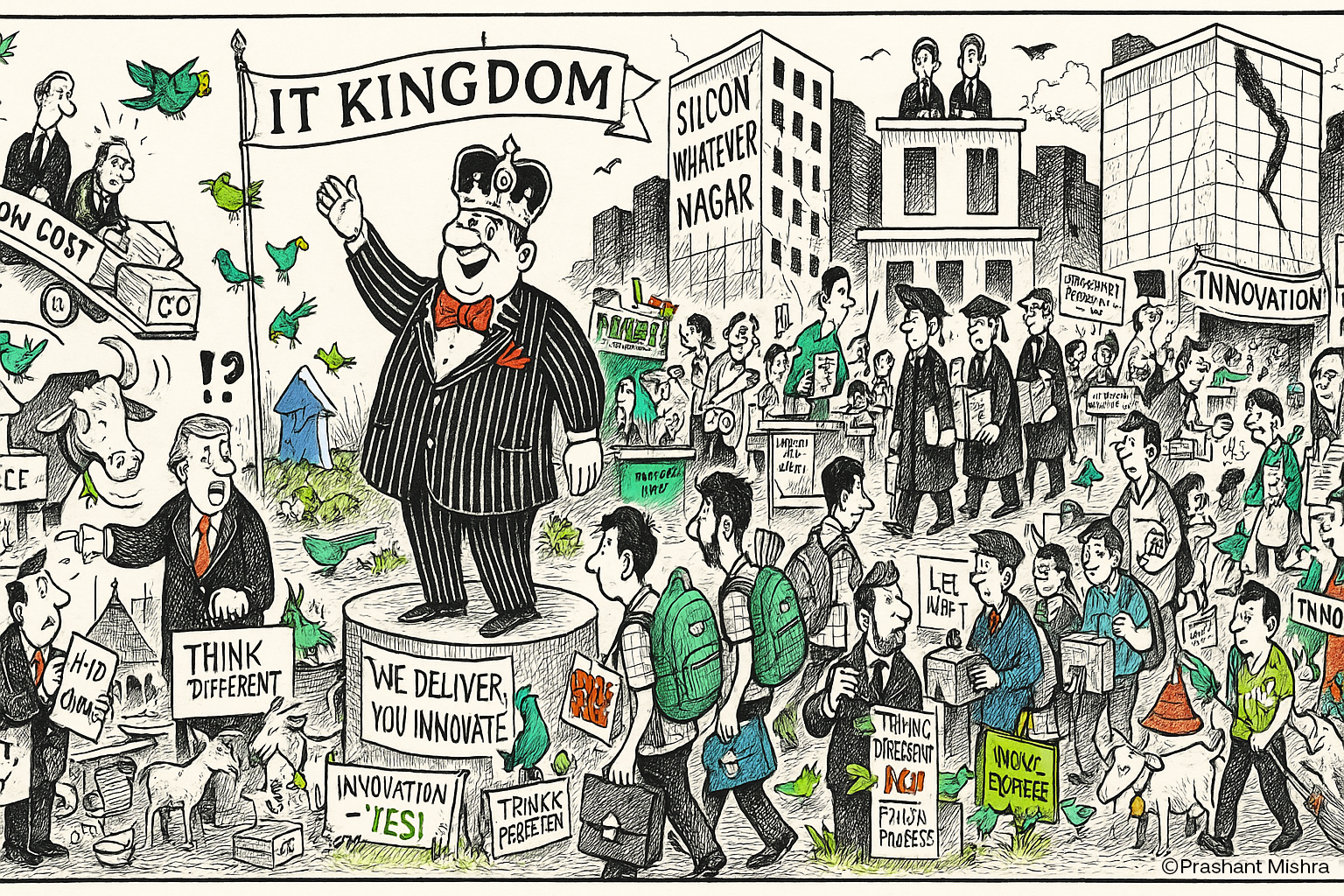
Galgotia’s Dog & India’s AI Aspiration: The maharaja has no clothes. But he is learning to weave.
India’s IT industry is often hailed as a modern miracle, a story of talent, ambition, and global triumph. Yet beneath that narrative lies a structural vulnerability: a workforce celebrated for execution yet underutilized in creative potential, and a nation applauded for output while remaining exposed to systemic fragility.
India's entry into the global IT market arose from a unique convergence of domestic and international forces. Liberalization in the 1990s accelerated entrepreneurship, reinforced by policies ranging from IT parks to fiscal incentives. Traditionally, Indians put much emphasis on STEM subjects and prized engineering/medical degrees. This social trend produced disciplined, numerate, English-speaking graduates. Meanwhile, corporations abroad battled European socialism, American high-salaries, and growing global competition. Facing rising labour costs, unionized employee-welfarism, and global expansion needs, India's capable workforce became a timely solution to rising global cost pressures. Domestic capability aligned with global demand, giving rise to an industry structurally positioned for rapid growth. The industry’s growth was propelled by execution efficiency. It leveraged a disciplined workforce to deliver high-quality work at lower costs as developed world clients benefited from the offshoring of routine tasks. India had found its global niche, leveraging its human capital and English-language advantage to rechart its economic trajectory.
But the foundation of this success rested less on creative ingenuity and more on systemic convenience. Indian education rewarded memorization over inquiry, compliance over experimentation. Students were trained to implement, not invent; to follow, not lead. Thus, IT Firms rewarded output and efficiency, not originality. Product creation was rare. R&D, rarer. The real work? Maintain, code, deliver—rinse and repeat. Unlike advanced enterprises which focused on creating new products and markets, Indian business houses prioritized cornering the largest share of existing markets. They angled for market cornering rather than disruptive invention. High-end engineering & R&D opportunities remain cornered in elite institutions and largely inaccessible. And the products of these elite institutions almost always migrated.
Indians excel at science & engineering, yet their achievements are contingent and externally dependent. Hardware design, component development, and proprietary R&D lag behind global competitors. China invested in internal manufacturing, satellites, and technology. India exported technical labour that maintained systems, wrote code, and implemented designs conceived elsewhere. They repaired and executed but rarely innovated.
The bulk of the Indian IT workforce was constrained by repetition and an ecosystem that systematically underutilized its intellectual potential. The IT sector became the default absorption point as it offered employment, financial stability, and the coveted “onsite assignment”, yet reinforced a cycle of execution over innovation. Engineering colleges became production lines, and graduates moved in herds toward IT placements.
Then came the H1B tightening under Donald Trump, exposing the fragility beneath the surface. The reaction exposed three uncomfortable truths.
First, IT had become a national strategic asset; but it had also become an Achilles’ heel, a point of systemic vulnerability exposed on the global stage. What had long been feared but seldom spoken aloud – that the workforce had been reduced to outsourced labour – was suddenly confirmed. Trump’s declaration was, in effect, a blunt articulation of what many had suspected for years: the Maharaja had no clothes.
Second, even more revealing was the silence of Indian executives in foreign organizations. Millions of social media posts celebrated Indian CIOs, CTOs, and CEOs at the helm of multinational corporations, yet none publicly contested the diktat. The signal was unmistakable: the wheat had been separated from the chaff. Those who have secured their positions and influence globally remain untouched, while the bulk of talent is left high and dry. This process, painful as it is, may serve as a societal “mohbhang,” a necessary awakening for Indians to confront illusions about the supposed global supremacy of their brightest minds and their so-called allegiance to their native land. It must force the country to confront uncomfortable truths about its dependence on external validation.
Third is the collapse of the illusion of status and innovation associated with geography. Calling a city “Silicon Valley” does not make it one. True innovation hubs are defined by a combination of talent, environment, creativity, risk-taking, and a relentless culture of experimentation. Concentrations of IT labour, no matter how dense, cannot substitute for ecosystems that actively cultivate original thought and disruptive technological development. Silicon Valley is not geography; it is a function of talent, environment, creativity, innovation, and the relentless hustle that accompanies risk and experimentation. It is not just a city with good weather and a lot of IT professionals.
The societal implications are stark: India's intellectual potential is harvested but channelled into creativity-killing low-end work. Generations of skilled graduates capable of much more may have become efficiency machines in repetitive roles. The critique runs deeper than economics—it's a cultural straitjacket. Education, society, and professional norms collectively reinforce conformity.
Indian IT grew spectacularly, fuelled by societal aspiration and global opportunity. Yet its structural underpinnings of market-cornering corporate behaviour, reliance on execution over creation, and outsourcing of intellectual ownership has left it vulnerable. Without systemic reform, investment in R&D, and a shift toward innovation-driven strategies, this industry was structurally vulnerable. In recent years, whether acknowledged or not, but the truth was that the consequences of earlier structural choices were becoming visible.
Recent developments suggest a second phase is quietly unfolding. Today the vocabulary has changed as dominant conversations are not so much about outsourcing or onsite assignments. It is more about Make in India, semiconductor fabrication, defence electronics, manufacturing-linked incentives, indigenous digital public infrastructure. It is about building, not just billing.
What began as back-office cost arbitrage is evolving into Global Capability Centers with increasing mandates in product engineering, AI research, and cybersecurity architecture. What began as cost arbitrage has evolved into strategic depth as decision-making is slowly migrating and not just tasks. Not to be left behind, India’s data center capacity is expanding at unprecedented pace. Hyperscale facilities are being built across Mumbai, Hyderabad, Chennai, and Noida. Cloud infrastructure is no longer just some abstract idea; it is physical capital. AI sovereignty is no longer rhetorical nationalism. It is strategic infrastructure. The digital economy requires not just engineers, but energy grids, fiber corridors, cooling systems, and regulatory clarity.
These shifts matter because they indicate a motivated movement from service dependence toward ecosystem building. From exporting labour to hosting infrastructure. From writing code for others to building platforms that others rely on.
But in all this euphoria, caution is still warranted. Because a GCC can very easily remain just an execution hub unless it internalizes product ownership. A data center is susceptible to become a warehouse for foreign algorithms unless India builds the models that inhabit them. A manufacturing initiative can assemble components without designing them. Therefore, the question remains whether we are participating in value chains or shaping them.
India’s digital public infrastructure, particularly the JAM Trinity spanning identity, banking, and payments, demonstrates architectural originality. Startup ecosystems are no longer derivative by default. AI research labs are emerging beyond elite institutions. Policy discourse now includes terms like deep tech, sovereign AI, semiconductor resilience. But transformation is not automatic and Infrastructure alone cannot compensate for the absence of imagination.
Money, investments, and financial resources often move based on cold logic or the pursuit of short-term profit. Moral courage, true bravery to do the right thing despite fear or risk is something much rarer. Therefore, the deeper shift required is cultural. Historically, students are trained to colour within lines; professionals rewarded for following scripts. Risk, experimentation, and intellectual audacity are systematically discouraged. The result: a society capable of brilliant execution yet paralyzed when asked to innovate independently. Recent, global socio-political conditions expose the erosion of intellectual independence and creative atrophy. Innovation cannot remain incidental. It must become intentional. Universities must reward inquiry, not compliance. Corporations must tolerate experimental failure, not merely optimize quarterly efficiency. Engineers must aspire to design systems, not just deploy them.
The path forward requires fundamental realignment. India’s earlier IT success was not a mistake. It was a stage of development. Execution built credibility. Credibility built capital. Capital now has the opportunity to build capability.
External applause will continue. Headlines will alternate between triumph and doubt. That is the nature of global perception. The more important question is: Will India choose to remain the world’s preferred implementer? Or will it patiently cultivate the intellectual independence required to become a creator of systems, platforms, and technologies that carry its own imprint?
The real test is whether we move from convenience to conviction.
The Maharaja was once exposed because he mistook borrowed cloth for sovereignty. Today, The Maharaja stands in a workshop, the loom stands before him. Manufacturing policy, GCC evolution, data centers, AI ambition. These are threads. But threads do not become fabric without design. Whether he learns to weave and what he weaves will determine the next chapter.
Recent Blog
-
Culture in the age of AI: The Illusion of Revival
Prashant M. 14 Feb, 2026 -

When Existing Is Enough : Ud Jayega Hans Akela, Jag Darshan ka Hai Mela
Prashant M. 04 Feb, 2026 -

2025: A year of Compression, Not Expansion
Prashant M. 05 Jan, 2026