The 7 Structural Shifts of AI in the Services Industry
“Artificial intelligence is going to be the efficiency booster, a game changer” — This view is already outdated.
The way things are evolving, AI is not improving old systems; it is — in all likelihoods — replacing them. Therefore, the important question is: “What will the old systems be replaced with?”
We often underestimate the extent to which AI will fundamentally alter the logic and patterns of business. This is because, the ideas of Digital transformation have become so ingrained that we almost naturally equate AI to another automation event. AI is not automation, it is architecture. It is not just beautiful prose; it is also grammar. It dictates how organizations will think, operate scale and deliver value.
In my book, the AI codex, I explain how AI is not just a technological phenomenon, but also a civilizational force. It will create new models, intelligence that will reshape human intent, industry, decisioning, and coordination.
In all this, business/organization is just the first frontier. And, if we look at the evolutionary trends, there are the 7 shifts that we can expect which represent the new contours of organizational strategy in the age of AI.
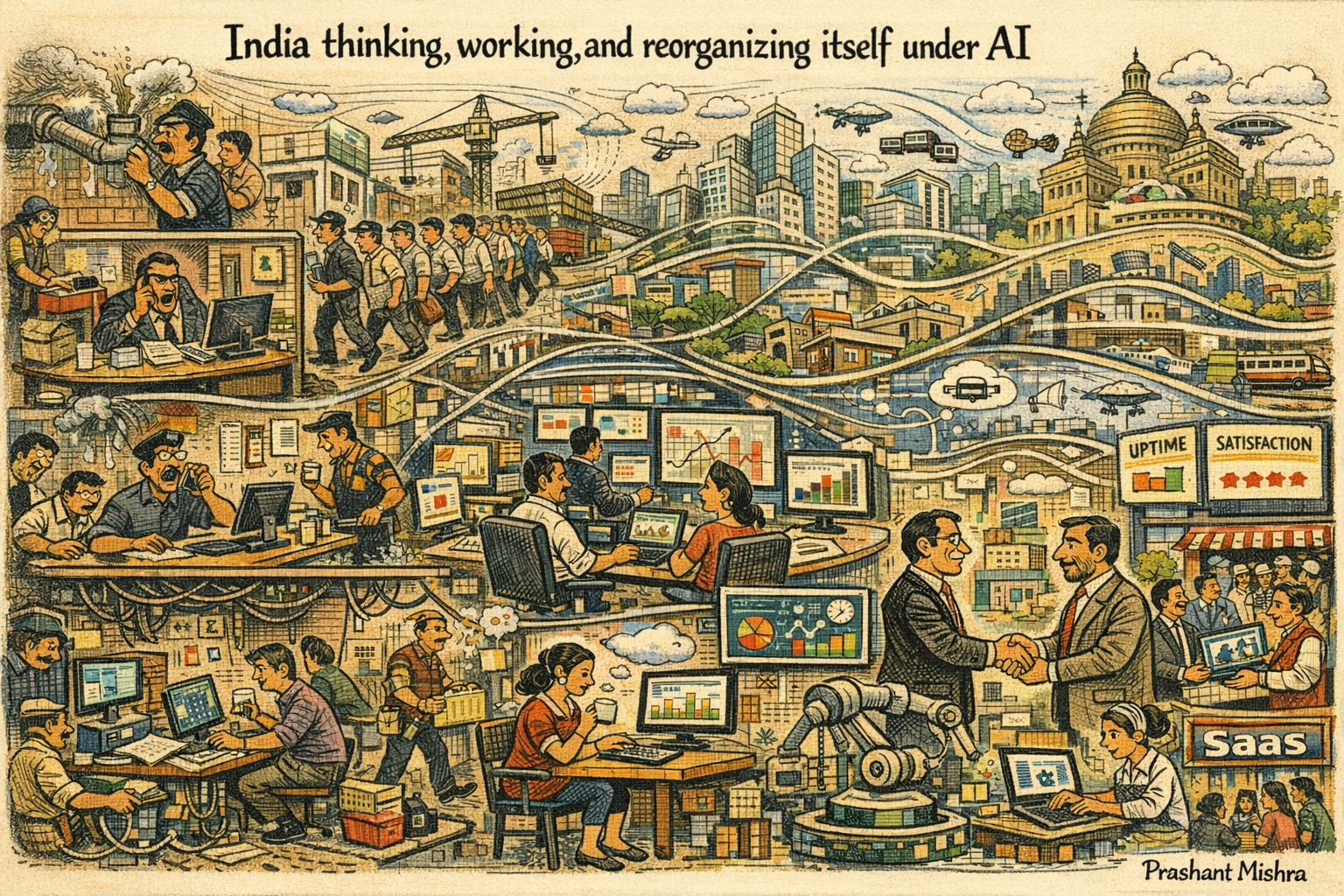
- From Service Provider to Intelligent, Autonomous Platforms: The traditional model is, people perform the process which may or may not be supported by machines and a senior human resource will oversee and manage the chaos. This pattern repeats at all levels. But AI will dissolve it. AI will push organizations away from human-led service delivery to autonomous system lead orchestration. Scheduling becomes dynamic. Resource allocation becomes digitised. Predictive maintenance becomes mainstream. Workflows route themselves. As AI embeds deeply, the product and the organization change fundamentally. Logistic companies no longer sell transport, but they sell load efficiency & precision delivery. Facility management stop selling housekeeping, they sell operational uptime. The migration is from managed manpower driven service operator to self-optimising ecosystem. In management science this is called a “category jump” and it sets the stage for everything else.
- From Asset Heavy Growth to Infinite Scale through AI Orchestration: In the earlier days, business boom equalled to adding more branches, offices, warehouses, people, etc. AI will buck this trend. As operational intelligence entrenches into the machines layer, organizations will invariably become the orchestrator rather than just the operator. Which means a new site may not need proportional headcount (think Digital Twin), new clients may not need extra operational staff (think digital operations). AI can listen to IoTs to predict failures, adjust or replicate workflows and optimise assets. Therefore, scale becomes digital, meaning AI allows scale without too much capital expenditure. Organizations expand without the proportionate growth of human supervision, and complexity can now be managed.
- From Reactive Operations to Prediction and Insight: Traditionally, the defining feature of any business (especially in the services sector) is “reaction”. Something needs attention, phone rings. Something breaks; someone responds. Something is amiss, someone escalates. It’s always about reaction, and performance is measured in terms of how quickly the reaction occurs. AI flips this dynamic, as “reaction” is now trumped by “prediction” as the core operating principle. Demands are anticipated. Assembly lines communicate limits. Vendor allocation is data driven. Failures get flagged even before happening. Billing anomalies are detected, corrected, communicated, and adjusted. AI enables organizations to see around corners. And this one change is the difference between life and death, as once “prediction” becomes normal, “reactive” organizations just cannot compete any further.
- From Charging for Inputs to Charging for Outcomes: This is not something new. Consulting companies have already shifted to this model, and it is more than likely other industry segments will follow suit. With AI, companies can guarantee performance and quantify results. They can document tasking and evidencing. They can measure customer experience. They can track utilization and optimise it. All this points to a segment shift in revenue models because organizations are no longer selling services, they are selling outcomes. Earlier, manpower equalled to revenue. Now verified performance equals revenue. Another aspect is the migration from low-margin zones to high value digital service models. Another outcome is establishment of more trust with customers as transparency and final outcome is more defined. For India’s large enterprise landscape, this shift is not just significant but long overdue.
- From Internal Tech Stack to Global Ready Operational Software: Technology is often viewed as internal function, cost-centre. But now a system that can perform predictions, optimizations, and complexity management is no longer just a system, it can also double up as a product. This means organizations can now develop and market this as a full-fledged product which can be exposed to others for adoption. Why acquire companies when they can be co-opted onto a company owned platform? So, this moves technology from the basement to the front display, opening up new markets. Thus, the whole organization moves on from being just a service provider to being a SaaS-plus-Service hybrid.
- From Static to Adaptive and Personalised Systems: AI is a phenomenon that makes environment almost behave as a living system. New workflows can reorganise based on load. Services, provisioning, or supply frequencies change on occupancy levels and usage. Food preparation or resource allocations adjust to foot falls or demands. In a nutshell, every element in the environment listens, learns, and adapts. And this creates new user experiences. People feel that the environment is aware of them. In this scenario both the customer and the employer are no longer passive elements but a dynamic link in the entire tapestry of the business ecosystem.
- From People-Driven Scaling to Machine-Driven Scaling: One of the principal challenges most Indian organizations face is the complexity that comes along with scale. In other words, operations become rapidly complex and people are unable to manage it. But for AI, this is the ideal situation. More digitization, more operational data. More data produces better AI. Better AI produces more margins, which lead to more expansion. It is the classic flywheel effect.
Bottom line, AI has a tremendous potential to radically transform organizations, migrating them from manpower dependent operators into intelligent autonomous and scalable platforms. But this transformation also requires ample dosage of caution and realization, especially in India’s people intensive sectors which employ tens of millions of workers and forms the backbone of the Indian economy.
Retail contributes 10% of the GDP and 8% of the employment. Hospitality and tourism 5% of the GDP and 9% employment. Logistics 14% of the GDP and 22+ million jobs. The security industry is the second-largest employer after Indian railways, with a 10 million workforce. The corresponding numbers of more glamorous segments such as High-Tech & manufacturing are eclipsed in front of these stats. So, AI’s impact on this service sector will be severe and have profound. The services sector is India’s great socio-economic stabilizer, employing those that might have minimal education or digital exposure.
AI’s promise of efficiency, scale, and high value is intellectually valid but economically disruptive, therefore it needs to be contextualised. We must understand that the goal is not to “automate away” the workforce, but to augment it with intelligence while absorbing human capacity into higher value roles. AI is not just a strategic lever but also a moral choice because the future is not “post human” it is “post linear” and so it demands human value led stewardship not just the thrill of blind scale.
Recent Blog
-
Galgotia’s Dog & India’s AI Aspiration: The maharaja has no clothes. But he is learning to weave.
Prashant M. 18 Feb, 2026 -

Culture in the age of AI: The Illusion of Revival
Prashant M. 14 Feb, 2026 -

When Existing Is Enough : Ud Jayega Hans Akela, Jag Darshan ka Hai Mela
Prashant M. 04 Feb, 2026